I apologize for this interruption in my Haiti reflections but I'm returning to topic for a moment. Namely, I've gotta talk about nature photography. Please bear with me.
As I write this it is Thursday April 14. Tomorrow is the start of 2011's Shoot The Hills photo competition. I am registered. My memory cards are formatted, my batteries are charged. I've cleaned the schmutz off my lenses and filters. And I AM READY TO GO!
I've blogged about STH before (here in January 2011 where I used the word 'incredible' three times)) and there's a link to the contest's website on the right. I just can't say enough about it.
To briefly recap why this photo contest gets me excited: it's not like other contests. At STH, all contestants start in the same place at the same time and have 24 hours to go out and capture an image from anywhere inside the Hocking Hills region of southern Ohio. This means it's a completely level playing field. We all have the same weather, the same lighting, the same early spring flora, fauna and terrain. As Fezzik said in The Princess Bride, "We face each other as God intended. Sportsmanlike. No tricks. No weapons. Skill against skill alone." (OK, so Fezzik was talking about a fight to the death with Westley and I'm talking about photographing birds and flowers, but it's the same idea...) (And I found the relevant clip here...)
The weather forecast for tomorrow and Saturday is less than pleasant. There's a better than even chance we will have rain for most of the 24 hours. That's OK with me. I've done rainy day photo shoots before, including last year's STH (where I took two ribbons). I have a complete set of rain gear...which includes a special poncho for my camera...so no big deal. You just have to be looking for something to shoot using a different eye, a different perspective.
I'll try to post something tomorrow night from my motel. Provided, of course, that I don't exhaust myself looking for the perfect shot or fall off a cliff (I'll be careful about that, trust me. I'm the State Trauma Coordinator and I know exactly how far I'll be from a trauma center in weather where Med Flight won't fly).
Wish me luck!

Thursday, April 14, 2011


Sunday, April 10, 2011
Haiti Reflections: Day 4 - March 18
The day began placidly. Dawn slowly broke and warm, tranquil sunshine began to fill the room, peacefully bringing each of us out of our slumbers.
Just kidding. Roosters and church bells.
Before we departed for the mountain village of Canon, Sarah lead us on a field trip. Today is Friday and Chantal's market day. The market is less than half a mile from the clinic and an easy walk.
We travelled down the dusty gravel road with a lot of the goods that were being taken to be sold. Some of it was carried on trucks, some on people's heads, some was still on the hoof.

The market was a typical third-world market. It's a large area with stalls that are little more than tall tree branches used as supports for corrugated metal roofs.

An assortment of goods could be purchased there. Lots of foodstuffs, including fish and shrimp, but mostly bric-a-brac. There was one stall that sold sticks. Sounds sad but these were bundled in varying lengths from a few inches to 6 or 8 feet and looked for the most part to be pretty straight and sturdy. Another stand sold nothing but rice sacks from relief agencies. No rice, just the sacks. But the relief agencies make sure those sacks are sturdy enough to have a long and useful life after the grain is gone.
A lot of livestock was also being hawked. Cattle, goats and pigs were plentiful. Sadly, our roosters were nowhere to be found.


After a cursory foray through the bazaar we headed back to the clinic.
16 of us piled into the Hilux. I was one of the 7 who got to sit in the cab (the one with 5 seat belts). 9 more were in the bed with the supplies. It was a very cozy 45 minute drive to Canon.
On the way to Canon we forded two rivers, one just outside Chantal, one closer to Canon. Both had very wide beds, but the one outside Canon had a considerable amount of water flowing through it - and this is the dry season. It was readily apparent that the people who live in and around Canon (and countless other Haitian villages) have a basic healthcare logistics problem. During the rainy season the rivers will be swollen and impassable. The locals can't get to help and help can't get to them. Simple things will become lethal. If your appendix ruptures, you're dead.
Canon is a teeny tiny village. When we arrived, people were lined up waiting. The line went on for quite some distance and we had a lot of work ahead of us. Father Lawrence, the local priest and a Barrack Obama look-alike, greeted us and showed us where we would be working.
Ginny and I were on triage. We were in a classroom that was hot, lit only by sunlight and had small windows without glass. With people lining up right outside, it was very noisy. We set our initial screening desk at the door (more crowd control tactics) and put the area for vital signs as far from the front as we could. This was only about 10 feet from the doorway so it didn't really help reduce the noise at all.
There was only one urgent situation where a lady collapsed but she was easily buffed up...Father Lawrence took her someplace nearby where her daughter could help her with a shower to cool down.
We had more problems with crowd control here than in Chantal because of the people being right outside our door. They were desperate for care and sometimes things got aggravated in line and they sort of surged. It was a hassle and a distraction but personally I couldn't be angry with them.
One observation I made (which was confirmed by Greg and Rebecca who triaged here yesterday) was that the hypertension wasn't quite as prevalent nor quite as high. Don't get me wrong, it was still really bad, but there was a marked difference between blood pressures in Chantal and Canon. This only adds to the mystery of Haitian hypertension (Haititension? Hypertaitian? Gonna have to work on that...)
Another observation I made was regarding something called "health literacy." There are many definitions but generally, health literacy is the ability to understand health information and to use that information to make good decisions about your health and medical care. There's no standardized scale for determining health literacy but if there was, Canon's would likely be close to zero.
Case in point: I was triaging when a 24 year old woman came in. Through Jean-Pierre, the translator, I learned she was having abdominal pain with her menstrual period. I asked how the pain was different from her normal period. There was a sort of puzzled, spluttering exchange between the patient and Jean-Pierre and I got a very non-specific answer. I don't recall what it was but I knew to try a different approach. I asked: "How long has this been going on?" The answer: "12 years." 12 years of painful menses in a 24 year old means that nobody ever told her that pain will accompany her periods. She wasn't alone. I had a handful of these, as did Ginny.
Triaging in Canon is also where the full impact of the term "lost in translation" hit me. When Haitians speak of pain in a particular body area, they tend to make sweeping gestures indicating the entire area is affected, whether that be head, chest, abdomen or limbs. It takes some work to narrow it down to what specifically, if anything specific, is hurting.
One elderly lady came in and her gesture was atypical. She didn't sweep across her chest with an open hand. Instead, she used a single finger to draw a fairly tight circle in the middle of her left pectoral.
Jean-Pierre: She says she has chest pain.
Me: Pain in her chest or in her breast?
Jean-Pierre: Uh, what is the difference between them?
Lost in translation. The translators are smart people (hell, I only speak one language) but they aren't medically trained. The difference between breast and chest seems obvious in English. But when translating, your vocabulary can be limited, especially when working in a specialized area like medicine or engineering or finance. If the only word you know for anything between the shoulders and the bottom of the ribs is 'chest' that's the word you have to use. This was something I hadn't been taking into account for the past three days and it still bothers me intensely that I may have been missing things because I wasn't paying closer attention to the patient-translator interaction.
In this case, Jean-Pierre quickly picked up the difference and got clarification that it was her breast. He also added the differential question to his repertoire (he made the difference clear in all subsequent females presenting with pain below the shoulders and above the abdomen). Sadly for this lady, by the time your breast tumor begins to hurt you're probably too far along to be helped by even the most advanced medicine.
Like yesterday in Chantal, the day in Canon was long and mind-numbing. There were a few people that we weren't going to be able to see. They were given white tickets that, if they could make it there, would get them to the front of the line in Chantal tomorrow.
Once everything wound down, we piled back into the Hilux. This time I got to sit in the bed. Oh, lucky me. Father Yves did a very good job of minimizing the bumps but these were rural gravel roads so it wasn't possible to miss them all. Sitting on the edge of the bed, clinging for dear life, was quite literally a pain in the ass. My hands were aching from my death grip. And because of the equipment in the back, my feet were contorted, which wasn't too bad in itself but Sarah kept sliding off the boxes she was sort of sitting on and onto my legs. Trust me folks, you just haven't lived until you've forded a Haitian river in the bed of a pickup with a physician sitting on your ankles.
We arrived back in Chantal as they were finishing their workload for the day. We had the standard dinner, Prestige and debriefing. Then off to bed.
Just kidding. Roosters and church bells.
Before we departed for the mountain village of Canon, Sarah lead us on a field trip. Today is Friday and Chantal's market day. The market is less than half a mile from the clinic and an easy walk.
 |
 |
| Chantal's main street |

The market was a typical third-world market. It's a large area with stalls that are little more than tall tree branches used as supports for corrugated metal roofs.

An assortment of goods could be purchased there. Lots of foodstuffs, including fish and shrimp, but mostly bric-a-brac. There was one stall that sold sticks. Sounds sad but these were bundled in varying lengths from a few inches to 6 or 8 feet and looked for the most part to be pretty straight and sturdy. Another stand sold nothing but rice sacks from relief agencies. No rice, just the sacks. But the relief agencies make sure those sacks are sturdy enough to have a long and useful life after the grain is gone.
 |
| Rice sacks for sale - Come to Chantal where relief efforts meet market capitalism |


After a cursory foray through the bazaar we headed back to the clinic.
16 of us piled into the Hilux. I was one of the 7 who got to sit in the cab (the one with 5 seat belts). 9 more were in the bed with the supplies. It was a very cozy 45 minute drive to Canon.
On the way to Canon we forded two rivers, one just outside Chantal, one closer to Canon. Both had very wide beds, but the one outside Canon had a considerable amount of water flowing through it - and this is the dry season. It was readily apparent that the people who live in and around Canon (and countless other Haitian villages) have a basic healthcare logistics problem. During the rainy season the rivers will be swollen and impassable. The locals can't get to help and help can't get to them. Simple things will become lethal. If your appendix ruptures, you're dead.
Canon is a teeny tiny village. When we arrived, people were lined up waiting. The line went on for quite some distance and we had a lot of work ahead of us. Father Lawrence, the local priest and a Barrack Obama look-alike, greeted us and showed us where we would be working.
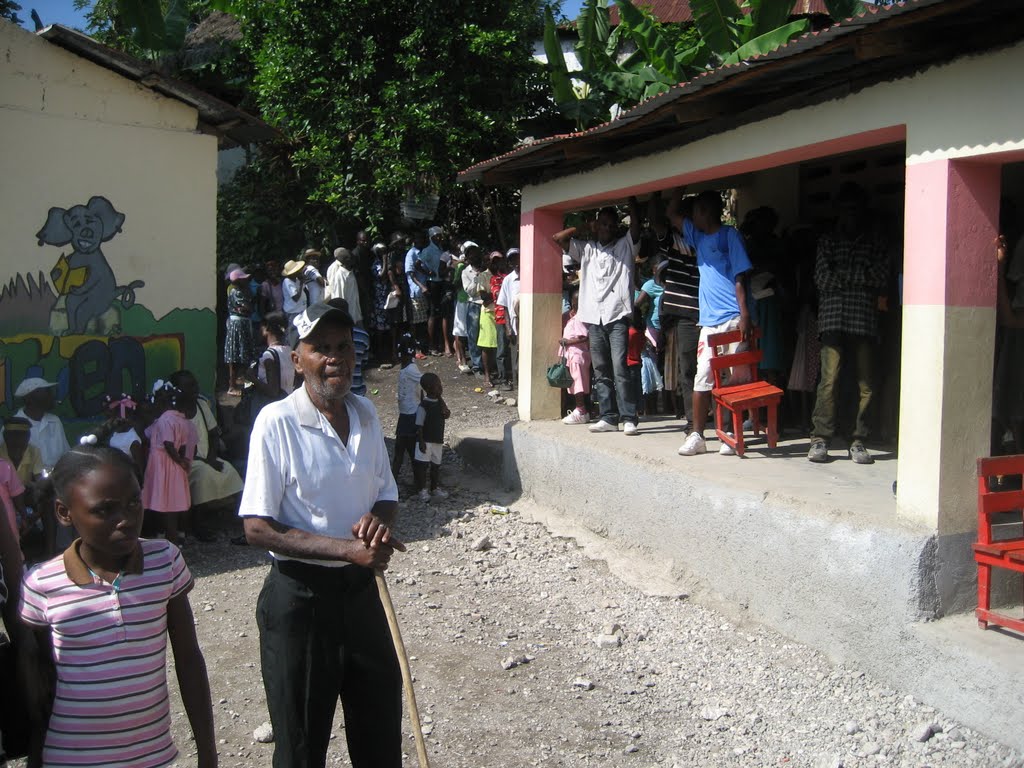 |
| Lining up for the doctor |
 |
| The pharmacy window |
 |
| Clouds blanket the hills on the other side of the valley |
There was only one urgent situation where a lady collapsed but she was easily buffed up...Father Lawrence took her someplace nearby where her daughter could help her with a shower to cool down.
We had more problems with crowd control here than in Chantal because of the people being right outside our door. They were desperate for care and sometimes things got aggravated in line and they sort of surged. It was a hassle and a distraction but personally I couldn't be angry with them.
One observation I made (which was confirmed by Greg and Rebecca who triaged here yesterday) was that the hypertension wasn't quite as prevalent nor quite as high. Don't get me wrong, it was still really bad, but there was a marked difference between blood pressures in Chantal and Canon. This only adds to the mystery of Haitian hypertension (Haititension? Hypertaitian? Gonna have to work on that...)
Another observation I made was regarding something called "health literacy." There are many definitions but generally, health literacy is the ability to understand health information and to use that information to make good decisions about your health and medical care. There's no standardized scale for determining health literacy but if there was, Canon's would likely be close to zero.
Case in point: I was triaging when a 24 year old woman came in. Through Jean-Pierre, the translator, I learned she was having abdominal pain with her menstrual period. I asked how the pain was different from her normal period. There was a sort of puzzled, spluttering exchange between the patient and Jean-Pierre and I got a very non-specific answer. I don't recall what it was but I knew to try a different approach. I asked: "How long has this been going on?" The answer: "12 years." 12 years of painful menses in a 24 year old means that nobody ever told her that pain will accompany her periods. She wasn't alone. I had a handful of these, as did Ginny.
Triaging in Canon is also where the full impact of the term "lost in translation" hit me. When Haitians speak of pain in a particular body area, they tend to make sweeping gestures indicating the entire area is affected, whether that be head, chest, abdomen or limbs. It takes some work to narrow it down to what specifically, if anything specific, is hurting.
One elderly lady came in and her gesture was atypical. She didn't sweep across her chest with an open hand. Instead, she used a single finger to draw a fairly tight circle in the middle of her left pectoral.
Jean-Pierre: She says she has chest pain.
Me: Pain in her chest or in her breast?
Jean-Pierre: Uh, what is the difference between them?
Lost in translation. The translators are smart people (hell, I only speak one language) but they aren't medically trained. The difference between breast and chest seems obvious in English. But when translating, your vocabulary can be limited, especially when working in a specialized area like medicine or engineering or finance. If the only word you know for anything between the shoulders and the bottom of the ribs is 'chest' that's the word you have to use. This was something I hadn't been taking into account for the past three days and it still bothers me intensely that I may have been missing things because I wasn't paying closer attention to the patient-translator interaction.
In this case, Jean-Pierre quickly picked up the difference and got clarification that it was her breast. He also added the differential question to his repertoire (he made the difference clear in all subsequent females presenting with pain below the shoulders and above the abdomen). Sadly for this lady, by the time your breast tumor begins to hurt you're probably too far along to be helped by even the most advanced medicine.
Like yesterday in Chantal, the day in Canon was long and mind-numbing. There were a few people that we weren't going to be able to see. They were given white tickets that, if they could make it there, would get them to the front of the line in Chantal tomorrow.
Once everything wound down, we piled back into the Hilux. This time I got to sit in the bed. Oh, lucky me. Father Yves did a very good job of minimizing the bumps but these were rural gravel roads so it wasn't possible to miss them all. Sitting on the edge of the bed, clinging for dear life, was quite literally a pain in the ass. My hands were aching from my death grip. And because of the equipment in the back, my feet were contorted, which wasn't too bad in itself but Sarah kept sliding off the boxes she was sort of sitting on and onto my legs. Trust me folks, you just haven't lived until you've forded a Haitian river in the bed of a pickup with a physician sitting on your ankles.
We arrived back in Chantal as they were finishing their workload for the day. We had the standard dinner, Prestige and debriefing. Then off to bed.
Thursday, April 7, 2011
Haiti Reflections: Day 3 - March 17
The day dawned with roosters crowing and church bells ringing...it's the way life is in Chantal. I managed to sleep really well despite the ruckus of the indigenous fauna. I was told by the other guys in the Barracks that they were as loud and as frequent as the previous night, I just was too tired to hear.
Got up and dressed and headed to breakfast. I'd like to pause for a moment to mention a really delicious part of breakfast that I left out of my previous description: the coffee. Rebo Coffee is a Haitian coffee that is dark, flavorful and robust, but it's not acid. It's this last part that a lot of people on the team commented on the most. I enjoyed it thoroughly (enough that I brought some home). Because the beans are grown and roasted there in Haiti (formerly the leading exporter of coffee in the Caribbean) I encourage everyone to buy some from them (http://www.rebo.ht/index.shtml). The Haitian economy could really use the boost and you'll get a great cup of joe in return.
The team that was going to Canon piled into Father Yves pickup - a fairly new Toyota Hilux with a crew cab. There were 16 people and a day's clinic supplies in a mid-size pickup that has 5 seat belts. Over on Juliet's blog, there are pictures of what it looked like. I called it the Haitian Mobile ICU.
As the clinic opened we began the triage process with just three of us, Bill, Connie and myself. Because half the docs were gone, we had to slow down and even frequently stop the flow of patients into the waiting area.
The chief complaints were largely the same as before but we did note a bit of a twist. It was more difficult to get details of what can be described as "female problems" and, to a lesser extent, "male problems." This was because of the make up of the the team doing the questioning: a female nurse and a male translator. Over dinner this was discussed and many were attributing it to culture, but I think that gender-specific medcial complaints/problems are hard enough to discuss with your own gender in your own culture. This was a source of frustration for the physicians because there were a large number of women with a complaint of "vaginal infection" who also had a host of other problems that were undiscovered until they got into the examining rooms.
Around midday, Diana, Fred and I assisted Sarah with a 2 year old boy who had second degree burns to his right should, upper arm and chest. He had hot water spilled on him. Sarah was having to do a fair amount of debriding (removing the dead tissue to prevent infection and allow healing). She did a good job despite not having the tools she really wanted.
Sarah had Mom lay down (on a desk at the back of Dr. Rich Salkowe's examining room) and hold the boy to her chest. The boy was remarkably calm. He cried and fussed, but Mom didn't have the titanic struggle on her hands that one would have expected. There was no wrestling match, she simply had to hold him snugly. (One of Shelagh's co-workers, Chris, who has also been to Haiti, said that Haitian children are more tolerant of pain than American kids, probably because of expectations - Haitian kids don't expect life to be pain free, Yankee guttersnipes (and their parents) do. It's an interesting theory that seems to have applied here.)
Once Sarah was done with the debridement, she applied a layer of lidocaine cream, numbing the area. The poor kid needed it...when Sarah finished applying the dressing and the lidocaine kicked in, he conked out. The family was referred to the Medicin sans Frontier clinic in Les Cayes where he can get the definitive treatment he needs for free. This was where I had my first chance to tell a patient, "Bon chance" as they departed. Both parents smiled gratefully at my small comment. But there's no guarantee they will take the little boy to the MSF clinic...we can only hope they did.
While this was going on, Rich (aka 'Doctor Reeshard') was continuing to see patients. He maintained an admirably even keel, despite sharing his room with a crying child, a medic, a nurse and a medical student scuttling around the searching for and retrieving equipment, and his translator being forced to translate for him and Sarah at the same time. Rich was a picture of equanimity.
Returning to triage: The hypertension continued to be overwhelmingly prevalent and catastrophically high.
I learned that having a good quality stethoscope has a drawback in this setting. Good stethoscopes will press gently into your ears so that they seal out external noise. It's part of what makes them good. But after taking about eleventy-thousand blood pressures, my ears HURT. When the ache started I glanced at my watch. It was only 11a.m. I was pretty sore by the end of the day (with a rare case of otitis externia).
The day was long and mind-numbing. When the team returned from Canon we had dinner and debriefed over our Prestige beer. We also made plans for tomorrow's split team. Greg and I will swap: he will stay in Chantal and I will go up to Canon.
It was St. Patrick's Day but because of fatigue the celebrations were subdued. I could have been convinced that the Prestige was green beer as, A) it was dark on the porch while we were drinking it, and B) we were drinking it right out of the brown glass bottles. Who would know what color the stuff was? But then I overheard an odd, trying-to-explain-my-culture conversation between a couple of nurses and a couple of translators. The nurses were wearing glowing shamrock necklaces. The translators wanted to know why (there's not much of a link between the Irish brand of Roman Catholicism and the Haitian brand so the holiday is completely unknown to them). The nurses explained that it was St. Patrick's Day, St. Patrick is the patron saint of Ireland and his day is always a big party and the Irish like to drink a lot and shamrocks are a symbol of Ireland. It was simply not being grasped, probably because the Haitians weren't going to understand why Americans were celebrating an Irish holiday in the first place. It was kind of like listening to somebody trying to explain baseball to a Martian.
At that point, I knew my beer wasn't green and I went to bed.
Got up and dressed and headed to breakfast. I'd like to pause for a moment to mention a really delicious part of breakfast that I left out of my previous description: the coffee. Rebo Coffee is a Haitian coffee that is dark, flavorful and robust, but it's not acid. It's this last part that a lot of people on the team commented on the most. I enjoyed it thoroughly (enough that I brought some home). Because the beans are grown and roasted there in Haiti (formerly the leading exporter of coffee in the Caribbean) I encourage everyone to buy some from them (http://www.rebo.ht/index.shtml). The Haitian economy could really use the boost and you'll get a great cup of joe in return.
The team that was going to Canon piled into Father Yves pickup - a fairly new Toyota Hilux with a crew cab. There were 16 people and a day's clinic supplies in a mid-size pickup that has 5 seat belts. Over on Juliet's blog, there are pictures of what it looked like. I called it the Haitian Mobile ICU.
As the clinic opened we began the triage process with just three of us, Bill, Connie and myself. Because half the docs were gone, we had to slow down and even frequently stop the flow of patients into the waiting area.
The chief complaints were largely the same as before but we did note a bit of a twist. It was more difficult to get details of what can be described as "female problems" and, to a lesser extent, "male problems." This was because of the make up of the the team doing the questioning: a female nurse and a male translator. Over dinner this was discussed and many were attributing it to culture, but I think that gender-specific medcial complaints/problems are hard enough to discuss with your own gender in your own culture. This was a source of frustration for the physicians because there were a large number of women with a complaint of "vaginal infection" who also had a host of other problems that were undiscovered until they got into the examining rooms.
Around midday, Diana, Fred and I assisted Sarah with a 2 year old boy who had second degree burns to his right should, upper arm and chest. He had hot water spilled on him. Sarah was having to do a fair amount of debriding (removing the dead tissue to prevent infection and allow healing). She did a good job despite not having the tools she really wanted.
Sarah had Mom lay down (on a desk at the back of Dr. Rich Salkowe's examining room) and hold the boy to her chest. The boy was remarkably calm. He cried and fussed, but Mom didn't have the titanic struggle on her hands that one would have expected. There was no wrestling match, she simply had to hold him snugly. (One of Shelagh's co-workers, Chris, who has also been to Haiti, said that Haitian children are more tolerant of pain than American kids, probably because of expectations - Haitian kids don't expect life to be pain free, Yankee guttersnipes (and their parents) do. It's an interesting theory that seems to have applied here.)
Once Sarah was done with the debridement, she applied a layer of lidocaine cream, numbing the area. The poor kid needed it...when Sarah finished applying the dressing and the lidocaine kicked in, he conked out. The family was referred to the Medicin sans Frontier clinic in Les Cayes where he can get the definitive treatment he needs for free. This was where I had my first chance to tell a patient, "Bon chance" as they departed. Both parents smiled gratefully at my small comment. But there's no guarantee they will take the little boy to the MSF clinic...we can only hope they did.
While this was going on, Rich (aka 'Doctor Reeshard') was continuing to see patients. He maintained an admirably even keel, despite sharing his room with a crying child, a medic, a nurse and a medical student scuttling around the searching for and retrieving equipment, and his translator being forced to translate for him and Sarah at the same time. Rich was a picture of equanimity.
Returning to triage: The hypertension continued to be overwhelmingly prevalent and catastrophically high.
I learned that having a good quality stethoscope has a drawback in this setting. Good stethoscopes will press gently into your ears so that they seal out external noise. It's part of what makes them good. But after taking about eleventy-thousand blood pressures, my ears HURT. When the ache started I glanced at my watch. It was only 11a.m. I was pretty sore by the end of the day (with a rare case of otitis externia).
The day was long and mind-numbing. When the team returned from Canon we had dinner and debriefed over our Prestige beer. We also made plans for tomorrow's split team. Greg and I will swap: he will stay in Chantal and I will go up to Canon.
It was St. Patrick's Day but because of fatigue the celebrations were subdued. I could have been convinced that the Prestige was green beer as, A) it was dark on the porch while we were drinking it, and B) we were drinking it right out of the brown glass bottles. Who would know what color the stuff was? But then I overheard an odd, trying-to-explain-my-culture conversation between a couple of nurses and a couple of translators. The nurses were wearing glowing shamrock necklaces. The translators wanted to know why (there's not much of a link between the Irish brand of Roman Catholicism and the Haitian brand so the holiday is completely unknown to them). The nurses explained that it was St. Patrick's Day, St. Patrick is the patron saint of Ireland and his day is always a big party and the Irish like to drink a lot and shamrocks are a symbol of Ireland. It was simply not being grasped, probably because the Haitians weren't going to understand why Americans were celebrating an Irish holiday in the first place. It was kind of like listening to somebody trying to explain baseball to a Martian.
At that point, I knew my beer wasn't green and I went to bed.
Saturday, April 2, 2011
Haiti Reflections: Day 2 - March 16 (part 2)
The number of people we saw with hypertension was staggering. It was in excess of 90% of the adults. And we're not talking about anything even close to normal B/P. In nearly 30 years of EMS, I've seen fewer people with pressures over 200 than I saw in those four days. Most of those EMS patients with B/Ps over 200 were suffering a traumatic brain injury or a stroke (hypertension is a common response to brain swelling); the Haitians were just walking around with it. The highest I measured was 264/130. We talked about it but we're at a loss for why this might be so prevalent and so severe.
Dental patients were in abundance and this was expected. Dental hygiene is non-existent and tooth decay is rampant. Our dentist, Dr. Joy Jordan, was one very busy lady.
Just before noon, two people - one male, one female, both elderly - were dragged (literally) into triage within minutes of each other. Both went down while waiting and were victims of heat, dehydration and probably low blood sugar. The guy had a seriously decreased level of consciousness and was cyanotic around his lips. He gave the distinct impression of a man actively trying to die on us. Both were taken to an area in the middle of the clinic that had a couple of beds, which became known as "The ICU" because that's where we took and treated all the seriously ill people. We started IVs on them to buff them up and worked with Dr. Vania Francois to get them back to their baseline. (Vania is Father Yves' sister.) (His sister as in biological sibling, not his sister as in a nun.)
There was a steady stream of kids headed to see our two pediatricians, Drs. Sarah John and Beau Laguerre. We didn't do triage on them as all aspects of kiddie care was being done by the pedi people.
In all, we saw over 600 people and told 500 to come back tomorrow. This was actually a low number as we got off to a late start due to having to set up.
After triage was finished processing the last patients of the day but they were still waiting to be seen by the physicians, Father Yves took me next door to show me the house his mother is building (his mother as in Mom and maternal progenitor, not mother as in a nun). It's a nice place and Mrs. Francois seems like a very nice lady. To turn out kids like Yves, Vania and Sondi (who was translating and helping out in general), she must be. It's also evident where they get their brilliant, ever-present smiles.
 |
| Sondi and Mrs. Francois |
Father Yves and I then went back to the school and I got another look around without kids this time. He told me that the school is going to have to be demolished and rebuilt, not because it was damaged or decaying but because it doesn't meet the new Haitian government earthquake codes.
Father Yves also told me about the deal that the government has made for the clinic. If a complete clinic is built (a new, purpose-designed building that is medically equipped), the government will provide two physicians to staff it full time. (Each person whose medical training is paid for by the Haitian government owes two years of service, so that's how it would be staffed.) The cost: $300,000.
When the last of the patients left the clinic, we headed to dinner. The food was, as described in an earlier post, tasty and satisfying. Father Yves also provided us with cold beer (!!!). Prestige beer is Haitian and a very nice beer. We didn't expect it, so it was that much more delightful. It also brought to mind Benjamin Franklin's saying: Beer is proof that God loves us and wants us to be happy.
After dinner, we debriefed, going over what went right and what could be done better. We also learned that the team would be split for the next two days with half going into the mountains to a village called Canon.
Greg and I talked it over and he would be the medic going up on the first day and I would go up on the second.
After the debriefing, I went to the Barracks, wrote my journal entry for the day and fell into a deep and easy sleep.
Haiti Reflections: Day 2 - March 16 (part 1)
Our first clinic day dawned and we grabbed our breakfast then started setting up.
We grabbed our baggage and began unloading it all, distributing the supplies we brought to the appropriate areas. These areas were triage, general medical, gynecology, dentistry, pediatrics, lab and pharmacy. There was also a storage area for overflow.
The section with the most setting up was the pharmacy. Everybody dedicated a sizable portion of their 100 pound luggage allowance to medications. Alex and Sharon, our pharmacists, had to sort out and organize the meds. They also set up a counting and dispensing system that seemed to work very well. The amount of work they and their assistants had to do to set up was enormous, and their level of work continued to be prodigious until the last patient left on Saturday.
Before the clinic gates were opened, we went next door to the church, Ste. Jeanne de Chantal. The church was opened up so that the people coming to the clinic would have a place to sit that was out of the sun and off the street. This was a to avoid a huge problem during the last mission - people were crowding the streets and then dropping like flies in the midday sun.
We entered to find the pews packed:

The picture above shows most, but not nearly all, the people waiting in the church. I'd guess that about 30% of the church's capacity is in additional pews on either side of the altar. There were also people waiting outside and more coming into town. As Father Yves introduced us as a group to those who were waiting patiently, I said a quick and quiet prayer for strength at the realization that this was just the tip of the iceberg.
After that, we went to the other side of the clinic to the school. The kids there were like kids the world over: happy, friendly and adorable. We were there as they assembled for their daily prayers.

The school rooms are spare but functional with desks and chalkboards. Annual tuition is $50. A pittance for us, a king's ransom for many of them. Each day they get a good education and lunch...for a lot of them it is the only meal they will eat.
We went back to the clinic to finalize our set up. I was in triage where we would determine the reason each person came to the clinic (their chief complaint) and take their vital signs. We also placed ourselves in the role of traffic cops. Diana, one of the nurses, placed a desk at a strategic point at the entrance to the building. This allowed us to control the flow into the waiting area, keeping it from getting out of hand (this was another problem encountered on the last mission: a waiting area so crowded nobody could move and so loud the physicians had difficulty hearing their patients).
We were also introduced to our translators. These were locals, mostly men but a couple of women, who had varying degrees of fluency but all were eventually situated where their abilities were matched to their task.
It was during these introductions that I saw it. I couldn't believe it. I stopped and looked a second time. I blinked. I checked my glasses. I wasn't seeing things. It was real.
Here I am in Haiti, some 1,500 miles from home physically. Culturally, I am on another planet. And yet there he was, a Buckeye fan:
Adzi (no idea how it's spelled but that's how his name is pronounced) has actually been to Columbus and has been on campus. He aspires to attend OSU. Having worked with him directly over the course of several days I can say he's probably bright enough, and certainly has enough fluency.
The walls of the compound were important to maintaining order. People were desperate for medical attention. The gate between the clinic and the church was another important "choke point" where the flow of people could be controlled. The local guys who manned the gates did a pretty good job of keeping things regulated and not allowing us to get overwhelmed. Here's a picture I took over the wall of what they were dealing with on the outside of the wall:

All of those people are crowded against the gate. Unfortunately, these are the ones who are younger, stronger and healthier than many of those waiting patiently in the church. If you've ever read Dale Carnegie, you'll recognize the idea that each person thinks of their own problem as being more important than yours. For these folks, their need for medical attention drove them straight to the gates, bypassing those who had been waiting. They were also driven by sense of urgency created by the brevity of our visit. They walked for hours in the heat to get there and knew that if they didn't get seen while we were there, it would be months before anyone would be back, if there's a return visit.
Then the gates opened.
Each person entering was sent to the initial triage area where they were given their "medical record." This was half a sheet of paper with spaces for their name, age, chief complaint, vital signs, physical exam, physician notes and treatment record. These records were collected from each patient before they left the clinic so that the nuns would have the ability to follow-up with those who might need it and so that there was some basic record of what we were seeing.
The initial triage area was outside the clinic, with benches set in the shade. The patients then went to the next "choke point" (Diana's strategically placed table) to get their name entered into a log. Bill was instrumental in crowd control at this point and wrote a LOT of names into the book. While some vital signs were being taken in the initial triage area, most were being taken in the area just behind the registration table. This was my main task (along with assisting Bill and Connie in controlling the occasional crowd surge).
After triage, patients were sent to the waiting area where they were then sent to the appropriate physician.
To be continued...
 |
| Dawn over the clinic. |
We grabbed our baggage and began unloading it all, distributing the supplies we brought to the appropriate areas. These areas were triage, general medical, gynecology, dentistry, pediatrics, lab and pharmacy. There was also a storage area for overflow.
The section with the most setting up was the pharmacy. Everybody dedicated a sizable portion of their 100 pound luggage allowance to medications. Alex and Sharon, our pharmacists, had to sort out and organize the meds. They also set up a counting and dispensing system that seemed to work very well. The amount of work they and their assistants had to do to set up was enormous, and their level of work continued to be prodigious until the last patient left on Saturday.
 |
| Alex and Sarah at the pharmacy's counting table. |
We entered to find the pews packed:

The picture above shows most, but not nearly all, the people waiting in the church. I'd guess that about 30% of the church's capacity is in additional pews on either side of the altar. There were also people waiting outside and more coming into town. As Father Yves introduced us as a group to those who were waiting patiently, I said a quick and quiet prayer for strength at the realization that this was just the tip of the iceberg.
After that, we went to the other side of the clinic to the school. The kids there were like kids the world over: happy, friendly and adorable. We were there as they assembled for their daily prayers.

The school rooms are spare but functional with desks and chalkboards. Annual tuition is $50. A pittance for us, a king's ransom for many of them. Each day they get a good education and lunch...for a lot of them it is the only meal they will eat.
We went back to the clinic to finalize our set up. I was in triage where we would determine the reason each person came to the clinic (their chief complaint) and take their vital signs. We also placed ourselves in the role of traffic cops. Diana, one of the nurses, placed a desk at a strategic point at the entrance to the building. This allowed us to control the flow into the waiting area, keeping it from getting out of hand (this was another problem encountered on the last mission: a waiting area so crowded nobody could move and so loud the physicians had difficulty hearing their patients).
We were also introduced to our translators. These were locals, mostly men but a couple of women, who had varying degrees of fluency but all were eventually situated where their abilities were matched to their task.
It was during these introductions that I saw it. I couldn't believe it. I stopped and looked a second time. I blinked. I checked my glasses. I wasn't seeing things. It was real.
Here I am in Haiti, some 1,500 miles from home physically. Culturally, I am on another planet. And yet there he was, a Buckeye fan:
 |
| Only hydrogen is more universal than the Buckeye Nation. |
The walls of the compound were important to maintaining order. People were desperate for medical attention. The gate between the clinic and the church was another important "choke point" where the flow of people could be controlled. The local guys who manned the gates did a pretty good job of keeping things regulated and not allowing us to get overwhelmed. Here's a picture I took over the wall of what they were dealing with on the outside of the wall:

All of those people are crowded against the gate. Unfortunately, these are the ones who are younger, stronger and healthier than many of those waiting patiently in the church. If you've ever read Dale Carnegie, you'll recognize the idea that each person thinks of their own problem as being more important than yours. For these folks, their need for medical attention drove them straight to the gates, bypassing those who had been waiting. They were also driven by sense of urgency created by the brevity of our visit. They walked for hours in the heat to get there and knew that if they didn't get seen while we were there, it would be months before anyone would be back, if there's a return visit.
Then the gates opened.
Each person entering was sent to the initial triage area where they were given their "medical record." This was half a sheet of paper with spaces for their name, age, chief complaint, vital signs, physical exam, physician notes and treatment record. These records were collected from each patient before they left the clinic so that the nuns would have the ability to follow-up with those who might need it and so that there was some basic record of what we were seeing.
The initial triage area was outside the clinic, with benches set in the shade. The patients then went to the next "choke point" (Diana's strategically placed table) to get their name entered into a log. Bill was instrumental in crowd control at this point and wrote a LOT of names into the book. While some vital signs were being taken in the initial triage area, most were being taken in the area just behind the registration table. This was my main task (along with assisting Bill and Connie in controlling the occasional crowd surge).
After triage, patients were sent to the waiting area where they were then sent to the appropriate physician.
 |
| Looking from triage into the waiting area |
 |
| Looking from the waiting area out to triage |
Subscribe to:
Posts (Atom)